Bringing Japan Home
Why a Tojiro FU-802, and Not a German Knife or a Shun
Affiliate disclosure: This page contains affiliate links. If you book or buy through them, we may earn a commission at no extra cost to you. As an Amazon Associate we earn from qualifying purchases.
CHOOSE YOUR NEXT STEP
- Everyday — Bring a Japanese-made blade into the small ingredients you prepare night after night.
- FU-802 puts the change in daily prep, not a souvenir drawer or luxury display case.
- Evidence: about $69, 150mm, VG-10 at HRC60, made in Tsubame, Niigata.
- Buy it for fruit, herbs, fish, and boneless meat; hand wash and keep it away from bone.
The short answer
Most souvenirs from Japan end up on a shelf. A Japanese knife changes something you do every night. The right petty knife is not a keepsake for a drawer; it is a way for a home cook to bring real Japanese blade culture into the work of slicing tomatoes, herbs, fruit, fish, and boneless meat. The Tojiro FU-802 is for someone who already has an ordinary knife and wants a real Japanese-made blade without paying a luxury-name premium.
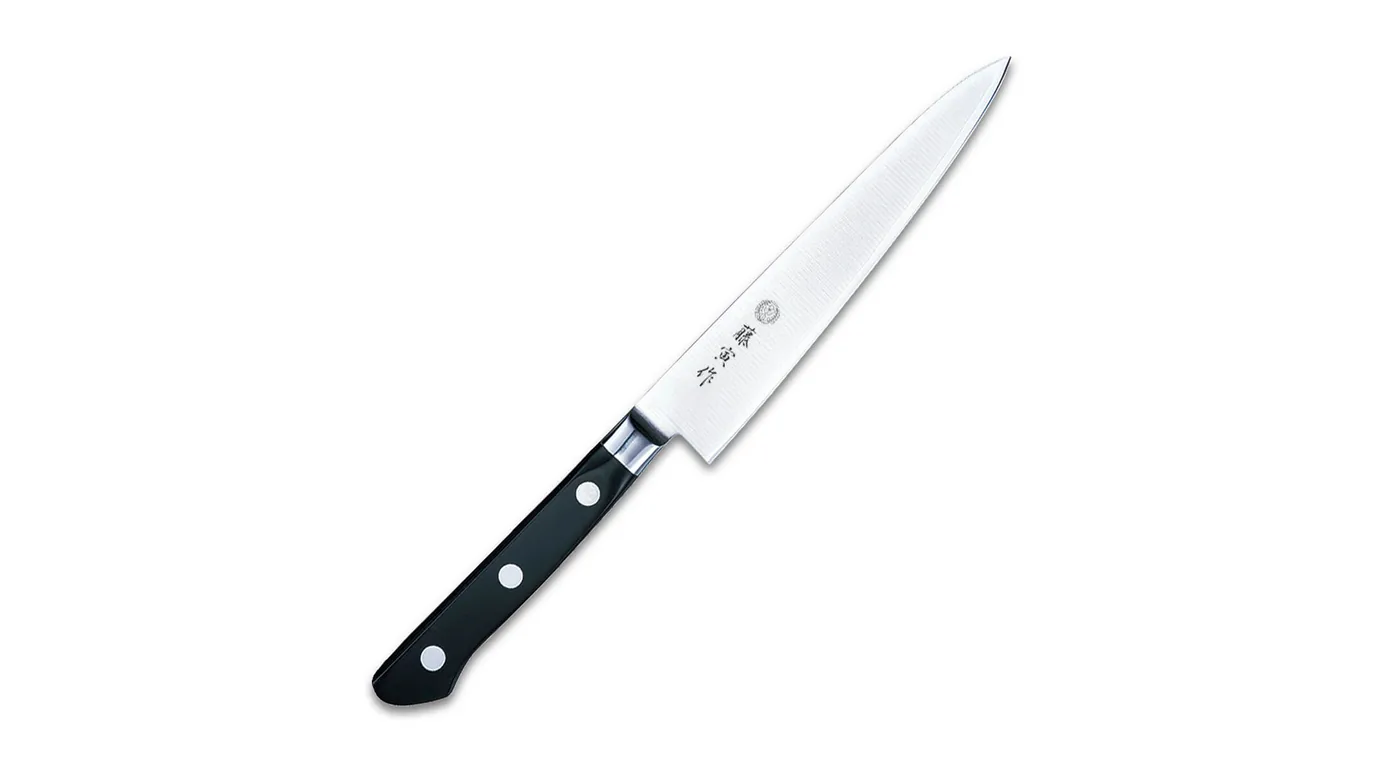
The proof is in the part that cuts. Read on August 24, 2026: about $69 on Amazon US, 4.7 from 363 ratings. It is a 150 mm petty knife, 260 mm overall and 80 g, with a VG-10 cobalt-alloy steel core, 13-chrome stainless cladding, and a double bevel. It is made in Tsubame, Niigata.
Two of those facts explain the appeal. VG-10 is a top-tier Japanese cutlery steel, the kind the expensive names are built on. Tsubame, in Niigata, is where it is made. Hold onto both as the comparisons begin.
Why a Japanese knife beats a German one
This is the first fork, and it comes down to one number: hardness, measured on the Rockwell scale.
A German knife from Wusthof or Henckels is ground from softer steel, typically around HRC 56. A Japanese knife like this one runs harder, around HRC 60. Harder steel tends to do two things a softer steel does less well. It takes a thinner, sharper edge, so the blade parts food instead of pushing through it. And it holds that edge longer, so with the same use a hard Japanese blade needs the stone far less often than a soft German one. How often depends on what and how much you cut, but the direction is consistent.
There is a price for the hardness, and we will not hide it: a hard, thin blade can chip if you twist it, drop it, or take it through bone or frozen food. This is a knife for vegetables, fish and boneless meat, washed by hand and dried. If that rules it out for your kitchen, buy the German knife and stop reading. If it doesn’t, the Japanese blade is simply sharper for longer.
Why Tojiro beats the famous names
So it should be a Japanese knife. The next question is which one, and this is where the FU-802 wins on the thing nobody puts on the box: where the money goes.
| Wusthof Classic (Germany) | Shun Classic (Japan) | Tojiro FU-802 (Japan) | |
|---|---|---|---|
| Blade steel | X50CrMoV15 | VG-MAX (Shun's own VG-10-family steel) | VG-10 |
| Hardness (Rockwell) | ~HRC 56 | ~HRC 60-61 | ~HRC 59-61 |
| Edge angle per side | ~14 degrees | ~16 degrees | ~9-12 degrees, traditional Japanese |
| What you pay for the handle | riveted synthetic | premium wood, high polish | basic laminated, plain finish |
| Rough price, petty size | $110-150 | $150-200 | about $69 (Aug 24, 2026) |
| Made in | Solingen, Germany | Seki, Japan | Tsubame, Niigata, Japan |
Read the steel row and the price row together. Shun’s Classic line uses VG-MAX, its own refinement of the VG-10 family with a little more chromium and vanadium; Tojiro uses VG-10 itself. They are close cousins, both hardened to around HRC 60, and the honest way to put it is that Shun’s steel is a modest step up, not a different league. What actually accounts for the two-to-three-times price is the rest of the knife: a pakkawood handle, Damascus-patterned cladding, a mirror polish and the brand. The Tojiro gives you a plain laminated handle and a workmanlike finish, and puts the money into the blade.
That is why, on the knife forums where people spend their own money, the answer to “my first real Japanese knife?” is so often Tojiro. It is the cheapest way to hold genuine VG-10 at HRC 60 in your hand. The steel figures above are the makers’ own published specs; the prices were read on the dates shown and move around, so check them before you buy.
The maker: Tsubame-Sanjo, and a knife that spends on the blade
Tojiro is the knife line of Fuji Cutlery, and it is made in Tsubame, in the Tsubame-Sanjo region of Niigata that has been Japan’s metalworking capital for four centuries. This is not marketing geography. It is the same district that makes the flatware and hand tools sold worldwide under other names.
The FU-802 is built by the method the maker calls warikomi, a three-layer lamination: a hard VG-10 core is sandwiched between two softer layers of 13-chrome stainless. The hard core holds the edge; the softer cladding takes the abuse and the rust risk. Ground as a double bevel at that shallow 9-to-12-degree angle, it sharpens up keen and is forgiving enough for a home cook to maintain. A steel bolster sits between blade and handle, which the maker points out keeps grime from collecting at the join.
Everything about the knife says the same thing the price does: pay for the blade, not the decoration. For a traveler carrying one knife home from Japan, that is exactly the right thing to have paid for.
Who it’s best for
The FU-802 is for a cook who wants a thin, hard edge for vegetables, fish and boneless meat, and who will hand wash and dry it after use. Its 150 mm petty shape suits peeling and trimming rather than bone or frozen food, while the plain laminated handle keeps the spend in the blade. It is also for someone who values a working Japanese knife over a polished presentation box.
For the one general-purpose knife most beginners actually want, we compare six of them, this one included, in our Japanese kitchen knife guide for beginners.
Getting one, briefly
Three ways to the same knife, in order of least fuss:
- Amazon US Global Store (the button above), about $69 as of August 24, 2026, shipped from abroad. Amazon’s own notice says international products ship from overseas, the documentation may be in Japanese, and the maker’s warranty may not apply; Amazon’s return window stands behind it instead. Import fees, if any, show at checkout and depend on your address, so the price is the item, not necessarily the landed total.
- A US-listed Tojiro DP, same maker and same VG-10 construction, at a higher price with local retail terms and English paperwork.
- Carry one home from Japan. A 150 mm petty is the easiest size to pack; it travels in checked baggage only. This removes the import step and adds a plane ticket you were buying anyway.
Bottom line
A German knife is softer and more forgiving. A Shun is a close-cousin steel with a beautiful handle at triple the price. The Tojiro FU-802 is genuine VG-10 at HRC 60, made in Tsubame, Niigata, sold with a plain handle so that the money went where it cuts. At about $69 it is the least expensive honest way to own a proper Japanese blade, which is why the people who buy knives for a living keep buying this one.